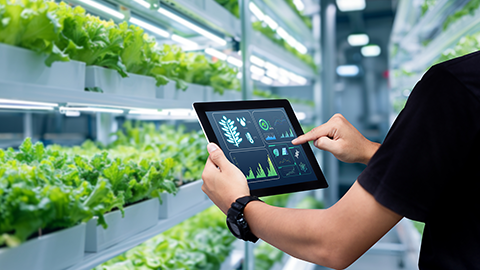
The May 2026 issue of Portugalglobal focuses on the agri-food sector, a field that has been undergoing transformation. In both agriculture and industry, the integration of technologies and the use of artificial intelligence have helped redefine processes, increase productivity, and address challenges related to sustainability and climate change. In Portugal, this sector includes around 124,000 companies and is increasingly grounded in data analysis, technology, and innovation.
The Portuguese agri-food sector has been establishing itself as a reliable producer and supplier of high-quality goods, says Miguel Teixeira in an interview. He is the scientific and executive director of Colab4Food, a collaborative laboratory whose aim is to enhance the competitiveness of the agri-food sector through innovation across academic and industrial entities. Innovation, he adds, has been the key driver behind the sector’s development, making it “more sophisticated, more capable of competing internationally, and better prepared to respond to global consumption trends”.
Discover also several Portuguese success stories that are driving innovation in the sector: Agroinsider, Agroop, Cell4Food, MG Paladin, Sogrape, Sumol Compal, and WiseCrop.
Portugal was the guest country at Morocco’s largest agricultural fair
Morocco is the featured market this month. With a dynamic economy and strong stability, Morocco should be viewed as a strategic market for Portuguese companies. Economic complementarity, cultural affinity, and geographical proximity provide clear advantages for Portuguese businesses entering the Moroccan market.
Portugal was the guest country at the 18th edition of SIAM – Salon international de l’Agriculture au Maroc, the leading agricultural fair in Morocco and across Africa, which took place from 20 to 26 April in Meknès. The Portuguese presence at the event was organised by AICEP and included two associations and 21 companies in a 400-square-metre exhibition space.
AICEP publishes study on opportunities arising from the EU–India Agreement
Negotiations for the Free Trade Agreement between the European Union and India concluded in January, and the agreement is expected to enter into force in 2027. It is estimated that, as a result, EU exports to India could increase by around 65 per cent by 2030, reaching €300 billion. AICEP has just published a study on the agreement aimed at helping companies understand upcoming changes and identify opportunities in the Indian market.