The UK’s National Oceanography Centre (NOC) has partnered with Portugal’s Madeira‑based ARDITI (the Regional Agency for the Development of Research, Technology, and Innovation), with support from the British Embassy Lisbon, to strengthen marine research capability in the North Atlantic.
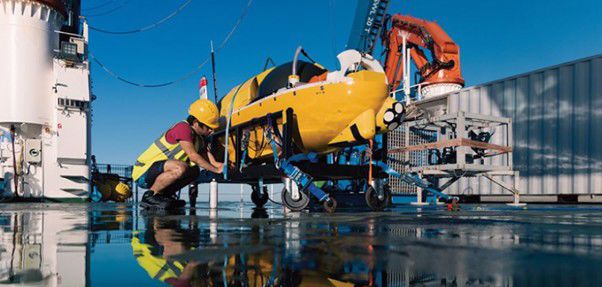
As part of this collaboration, ARDITI acquired two autosub long range (ALR) autonomous underwater vehicles developed by NOC and valued at 4.3 million euros. The agreement supports the deployment of advanced UK marine robotics in the deep waters around Madeira, an area well suited to ultra‑deep‑sea research, while establishing a strategic partnership for future joint scientific activity.
ALRs are designed for long‑duration missions and can be fitted with modular sensors to collect data throughout the water column and across the seabed. One vehicle is rated to depths of 1,500m and will support oceanographic and biogeochemical research. The second is rated to 6,000m and will be used for deep‑sea mapping.
The vehicles use an open‑source operating system and are compatible with existing marine platforms. This allows ARDITI to integrate them quickly into its research programmes, alongside uncrewed surface vessels, and conventional research ships. Operations will be managed through the Ocean Observatory of Madeira (OOM), helping to position Madeira as an international hub for deep‑sea testing and research.
Know more.
As part of this collaboration, ARDITI acquired two autosub long range (ALR) autonomous underwater vehicles developed by NOC and valued at 4.3 million euros. The agreement supports the deployment of advanced UK marine robotics in the deep waters around Madeira, an area well suited to ultra‑deep‑sea research, while establishing a strategic partnership for future joint scientific activity.
ALRs are designed for long‑duration missions and can be fitted with modular sensors to collect data throughout the water column and across the seabed. One vehicle is rated to depths of 1,500m and will support oceanographic and biogeochemical research. The second is rated to 6,000m and will be used for deep‑sea mapping.
The vehicles use an open‑source operating system and are compatible with existing marine platforms. This allows ARDITI to integrate them quickly into its research programmes, alongside uncrewed surface vessels, and conventional research ships. Operations will be managed through the Ocean Observatory of Madeira (OOM), helping to position Madeira as an international hub for deep‑sea testing and research.
Know more.